How to Verify an OpenAI Service Partner Before You Shortlist
Firms announce OpenAI partner status in press releases, on service pages and in proposals. Most of those claims are accurate. Checking which ones are takes about twenty minutes, and the checks are worth running before a partner reaches a shortlist rather than after.
This is a verification guide, not an evaluation guide. It answers whether a firm is what it says it is. Whether a firm is any good is a separate question, and we set out the four we would ask about the work itself in our guide to evaluating an OpenAI implementation partner.
Why claims outrun reality
Rarely through dishonesty. A firm's application is accepted, the internal announcement goes out, the marketing page updates, and OpenAI's public directory catches up on its own schedule. The gap between those events is where the confusion sits.
There is a documented instance. One consultancy published a company blog post announcing it had joined the network as a Select partner on 5 October 2026, and redistributed the same text through a newswire on 19 October. An independent check on 20 October found the firm listed neither in OpenAI's partner locator nor on OpenAI's partners page.
That is not evidence of a false claim. It is evidence that an announcement and a listing are different artifacts with different timing, which is exactly why a buyer needs a check that does not depend on either one alone.
The five checks
1. Ask for the tier in OpenAI's own wording
OpenAI runs three tiers: Select, Advanced and Elite. A firm should be able to name which one it holds, using OpenAI's own term for it.
Phrases to query rather than accept: "official OpenAI partner", "OpenAI certified agency", "OpenAI approved". None of those is a tier in the program, and a firm using one instead of a tier name is either imprecise or describing something else.
2. Ask for written confirmation
The status comes from OpenAI, so OpenAI's confirmation of it exists. Asking to see it is a reasonable request and a quick one to satisfy.
This is the check that resolves the timing gap above. A firm accepted last month has the confirmation even if the public directory has not updated.
3. Check the partner locator, and read its absence correctly
OpenAI publishes a partner locator. An independent count on 20 October 2026 found 73 firms in it, 70 carrying a tier.
Presence is useful. Absence proves less than it appears to, for two reasons: the directory's listing rules have changed since the program launched and have been reported differently by partners at different tiers, and a recently accepted firm can be in the network before the page shows it. Absence is a reason to ask for check 2, not a reason to disqualify.
4. Query any specialization claim
OpenAI named specializations at launch in areas including Codex, cybersecurity and agents, and its wording was that partners "will also be able to earn" them. Future tense, written in June 2026.
If a firm claims a specialization, ask where OpenAI displays it. That is not an aggressive question. It is the same question OpenAI's own phrasing invites.
5. Separate the firm's status from your contract
A partner's tier says nothing about what you are buying from OpenAI. Seats and API usage are contracted directly with OpenAI in your own organization in most arrangements, at OpenAI's published or quoted prices, and the partner's services are scoped and priced separately.
Confirm which model is being proposed before the commercial conversation starts. The two are often described together in a way that implies the partner is reselling when it is not.
What verification cannot tell you
A verified tier confirms a relationship. It does not confirm delivery, and nothing in the program is designed to.
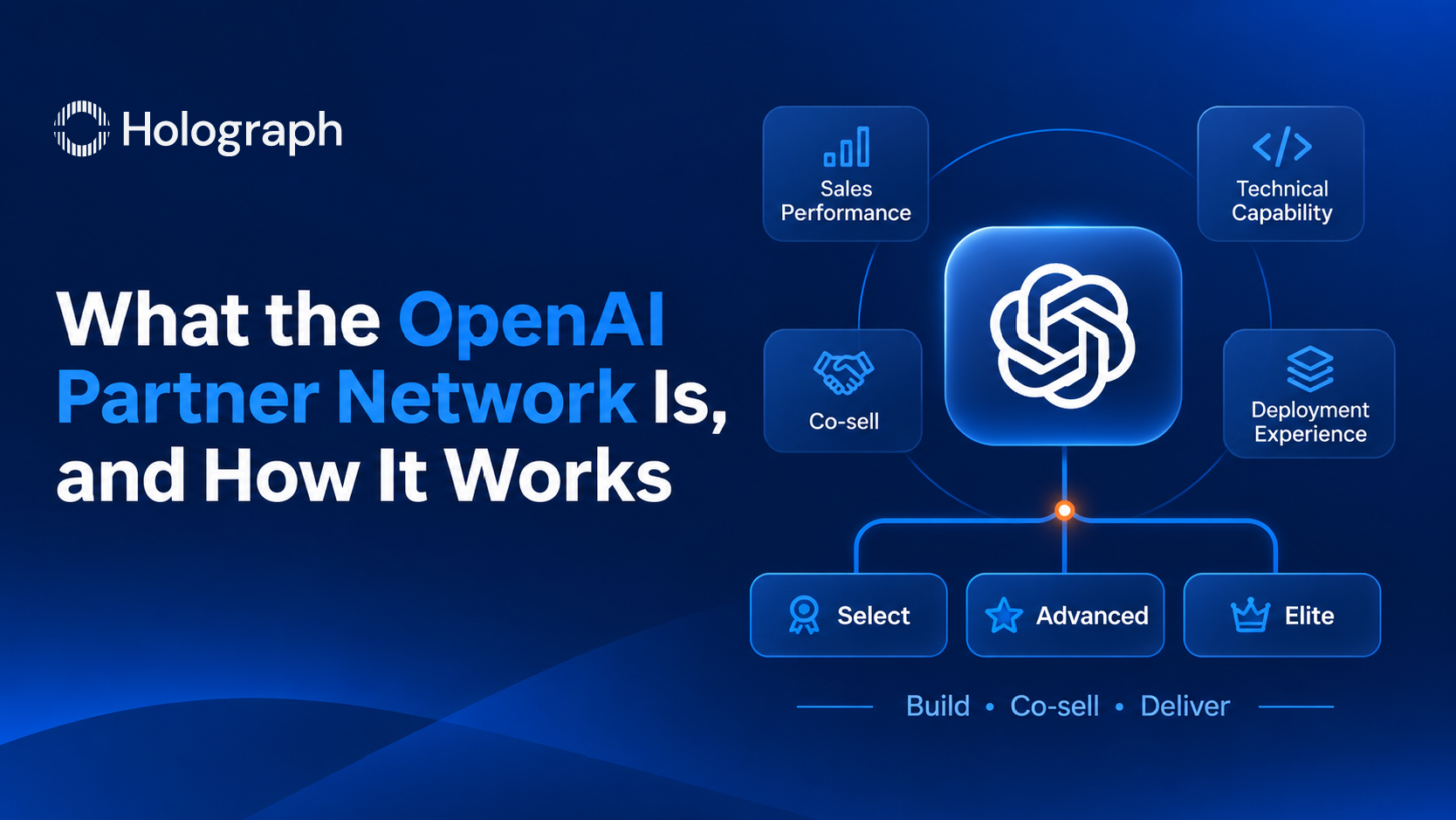
OpenAI does not inspect the systems a partner builds. Tier assignment weighs the firm's sales performance, technical capability, co-sell engagement and deployment experience with OpenAI, and OpenAI publishes no threshold for any of the four. OpenAI's partner brand guidance also asks partners not to imply endorsement, which is worth remembering when a proposal reads as though the relationship carries a guarantee.
So a verified claim moves a firm onto a shortlist and no further. What moves it along the shortlist is a named team, a comparable deployment with the measurement that went with it, and a written scope.
A short note on our own position
We are part of the OpenAI Partner Network. Every check above applies to us, and we would expect a buyer to run them.
We will also say the part that works against our own interest, because a verification guide written by a firm with a credential is worth less if it quietly exempts the author. Program membership is a weak signal on its own. We would rather be assessed on what we commit to in writing before work starts than on a badge, which is the position we take at more length in our guide to evaluating an implementation partner.
The program itself, including how the tiers and specializations work, is explained in what the OpenAI Partner Network is, and the entry tier specifically in what an OpenAI Select Partner is. Our client work sits in enterprise estates where new systems run alongside what is already there.
Start with a two-week assessment and keep the document, whatever you decide next.
Frequently asked questions
How do I check if a company is really an OpenAI partner?
Ask for the tier in OpenAI's own wording, ask to see written confirmation of the status, and check OpenAI's partner locator. Treat presence in the locator as confirmation and absence as a prompt to ask for the written confirmation rather than as a disqualification.
What is the difference between an OpenAI service partner and an implementation partner?
In most procurement documents they describe the same role. OpenAI's program covers firms that build, sell and deliver AI solutions on its technology, and the terms are used interchangeably by buyers and by firms.
Does OpenAI list every partner publicly?
It does not list every firm at every tier consistently. An independent count on 20 October 2026 found 73 firms in the locator, 70 showing a tier, and partners have reported the listing rules differently depending on tier and enrollment year. Written confirmation from OpenAI is the more reliable check.
Can a firm claim OpenAI partner status before it appears in the directory?
Yes, and legitimately. Acceptance and public listing are separate events with separate timing. One firm announced Select status on 5 October 2026 and was still absent from the locator on 20 October, which is a timing gap rather than evidence of a false claim.
What does an OpenAI partner tier actually guarantee?
It confirms that a firm applied, was accepted and completed onboarding at a named tier. OpenAI does not review the systems a partner builds, publishes no numeric threshold for the tiers, and asks partners not to imply endorsement.
Should I pay more for a higher-tier partner?
Tier is a screen rather than a price justification. The things that should move a price are the named team, a deployment comparable to yours, and what the firm commits to in writing before the work starts.
Start with a two-week assessment