What the OpenAI Partner Network Is, and How It Works
OpenAI announced the Partner Network on 14 June 2026. It is the program through which outside firms build, sell and deliver AI solutions on OpenAI technology, and it arrived with $150 million committed to the ecosystem and a stated target of training and enabling 300,000 certified consultants by the end of 2026.
If a vendor has told you it is an OpenAI partner, this is the thing they are referring to. Here is what the program contains, what it asks of the firms inside it, and what the membership actually certifies.
Why OpenAI built it
The announcement opens with a diagnosis rather than a product claim. In OpenAI's own words, "the limiting factor for seeing value from AI in the enterprise is no longer model capabilities. Instead, it's how organizations repeatably identify the right use cases, redesign workflows, integrate with existing systems, and drive adoption and change management at scale."
That is a model vendor stating that the model is not the hard part. The Partner Network is its answer: an ecosystem of firms that do the work the model cannot do for itself.
The three tiers
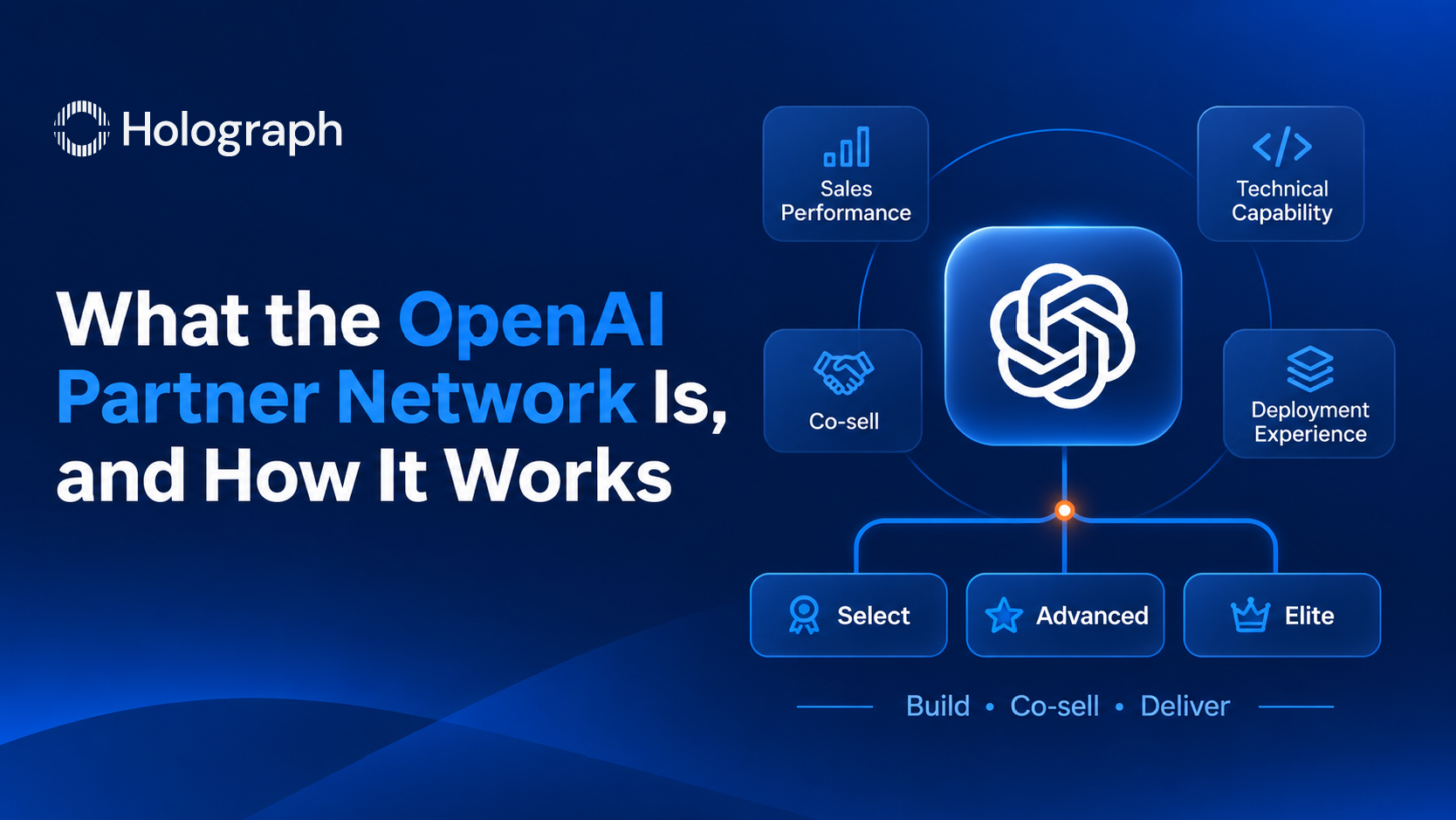
Partners progress through Select, Advanced and Elite. OpenAI assesses all three against the same four measures: sales performance, technical capability, co-sell engagement and deployment experience.
OpenAI publishes no numeric threshold for any of them. There is no revenue floor, no certified headcount and no deployment count in the public program material. The tiers describe a firm's standing with OpenAI rather than a figure a buyer can compare across vendors.
The distribution is public, because OpenAI runs a partner locator. An independent count on 20 October 2026 found 73 firms listed, 70 of them carrying a tier: 33 Advanced, 27 Select and 10 Elite. Three security specialists appeared with no tier label at all.
What that distribution shows is where the firms sit, not how good they are. Elite holds the global consulting houses and integrators. Advanced holds large national firms alongside small specialist houses. Select holds a mix wide enough to include both boutiques and listed companies with tens of thousands of staff.
Specializations, and a point of tense
Alongside the tiers, OpenAI said partners "will also be able to earn specializations" in areas including Codex, cybersecurity and agents.
Read the tense. That sentence is future, and it was written in June 2026. If a firm tells you it holds an OpenAI specialization, the reasonable next question is where OpenAI displays it.
The Forward Deployed Experts pilot
For complex enterprise deployments, OpenAI is piloting a Forward Deployed Experts program with a set of founding partners. Qualifying partner practitioners work alongside OpenAI's own Forward Deployed Engineering teams and take the deployment playbooks and transformation patterns back into their client work.
It is a pilot rather than a broadly available track, and it is the one element of the program that involves OpenAI staff actually working next to partner staff on customer systems. That makes it a more specific signal than a tier, and a rarer one.
How a firm joins
OpenAI describes three stages. Enroll: the firm submits its capabilities, technical expertise and customer experience to be considered. Enable: it gets onboarding, training and resources. Grow: it works with OpenAI on customer success and practice development.
The first stage is a review, which matters for how much the membership proves. A firm in the network has had an application assessed by OpenAI and has completed onboarding. OpenAI has not inspected a system that firm built.
What the membership certifies, and what it does not
It certifies that a relationship exists. The firm applied, was accepted, and holds a position in a program OpenAI runs. That is a verifiable fact and it is not nothing.
It does not certify delivery. No code, architecture or finished deployment is reviewed as part of tier assignment. The four measures are about the firm's activity with OpenAI, not about the quality of what it built for its last client.
It is not an endorsement. OpenAI's partner brand guidance asks partners not to imply endorsement or misrepresent the relationship. A proposal that reads as though OpenAI vouches for a firm's delivery is the firm's framing.
It does not change what you buy. OpenAI's products, terms and data commitments are the same whether a partner is involved or not. Seats and API usage are contracted with OpenAI directly in most arrangements, and the partner's services are scoped separately.
Where this sits for a buyer
The network is a useful first screen and a poor final answer. A firm's presence in it tells you OpenAI recognizes the firm. A firm's absence tells you nothing on its own, since the locator's listing rules have changed since launch and a recently accepted partner can be in the network before the directory shows it.
What turns program membership into evidence is the specific thing: a named team, a comparable deployment, a written scope. We are part of the OpenAI Partner Network, and we would give you the same advice about our own standing.
For the full set of questions worth putting to any firm before you sign, see our guide to evaluating an OpenAI implementation partner. For what the entry tier specifically signals, see what an OpenAI Select Partner is.
Our work sits in enterprise estates where new platforms have to operate alongside the systems already running, which is the condition most AI programs meet rather than the clean deployment the demonstrations assume. Our client work reflects that, and the same discipline shows up in how we handle software licensing across multi-vendor environments.
Start with a two-week assessment and keep the document, whatever you decide next.
Frequently asked questions
What is the OpenAI Partner Network?
The program OpenAI launched on 14 June 2026 for firms that build, sell and deliver AI solutions using its technology. It came with $150 million committed to the ecosystem and a target of training and enabling 300,000 certified consultants by the end of 2026.
What are the OpenAI partner tiers?
Select, Advanced and Elite. OpenAI assesses all three on sales performance, technical capability, co-sell engagement and deployment experience, and publishes no numeric threshold for any of them.
How many firms are in the OpenAI Partner Network?
An independent count of OpenAI's partner locator on 20 October 2026 found 73 listed firms, 70 of them showing a tier: 33 Advanced, 27 Select and 10 Elite. The locator is OpenAI's own directory and the count changes as firms join.
Does OpenAI endorse its partners?
It does not. Membership reflects an accepted application and a completed onboarding, and OpenAI's partner brand guidance asks partners not to imply endorsement. OpenAI does not review the systems a partner builds for its clients as part of tier assignment.
What are OpenAI partner specializations?
Areas of declared depth, named at launch as Codex, cybersecurity and agents. OpenAI's wording was that partners "will also be able to earn" them, which is future tense, so a claim to hold one is worth checking against what OpenAI displays.
Do I have to buy OpenAI through a partner?
In most arrangements you do not. Seats and API usage are contracted with OpenAI directly in your own organization, and a partner's services are scoped and priced separately from them.
Start with a two-week assessment