How to Evaluate an OpenAI Implementation Partner
OpenAI's API is open to anyone with a credit card. A competent engineering team can call a model this afternoon, wire it into an internal tool by Friday, and demonstrate something impressive on Monday. Any honest account of what an OpenAI implementation partner adds has to start by conceding that.
Access was never the hard part. What you pay a partner for is everything that happens after the demo works.
The terms vary and the role does not. Enterprise AI implementation partner, OpenAI service partner and OpenAI implementation partner describe the same thing in most procurement documents, and the OpenAI Partner Network is the program that formalized it in 2026.
Key takeaways
- OpenAI's own Partner Network announcement states that model capability is no longer the limiting factor for enterprise AI value, and that implementation is.
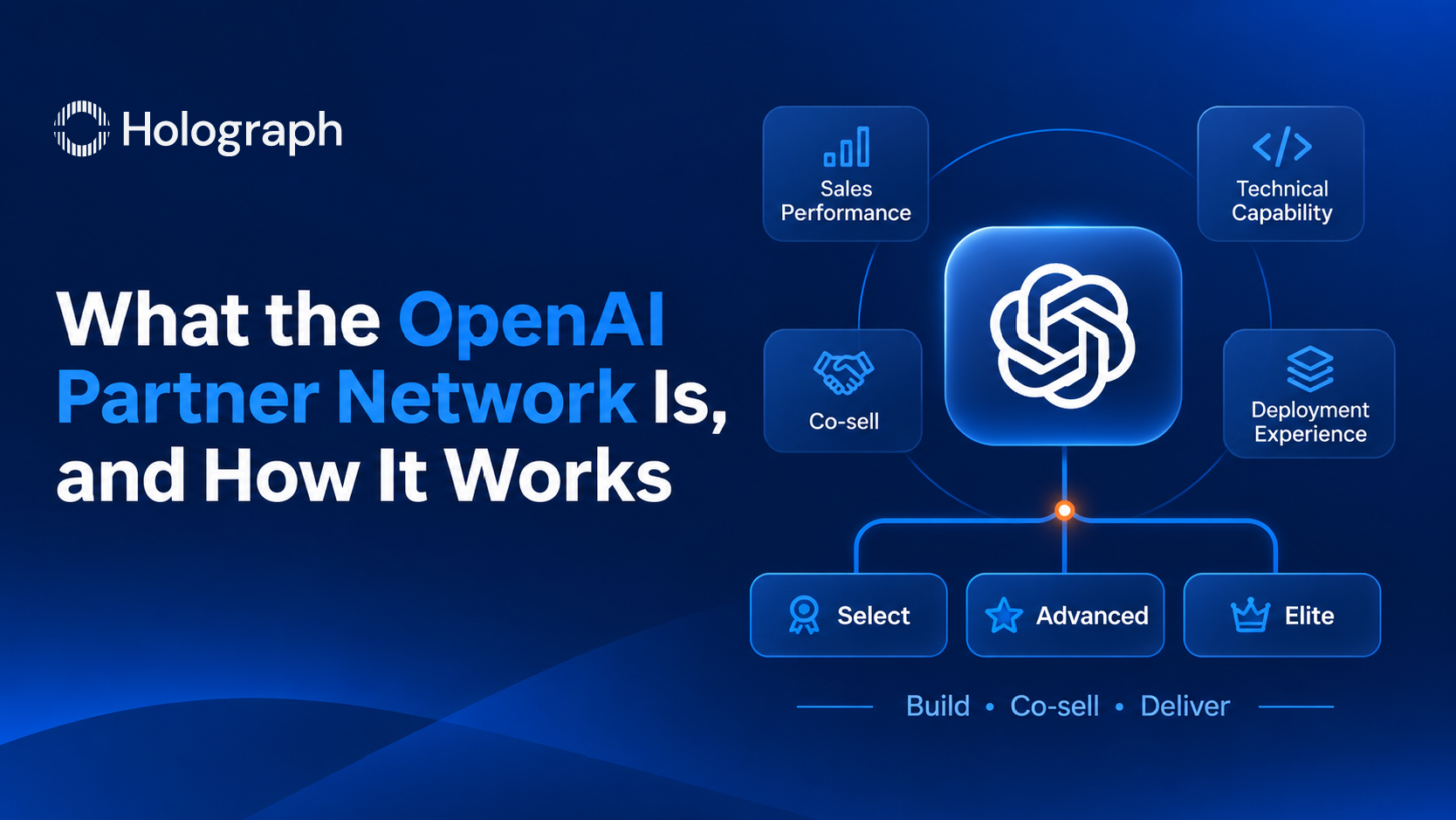
- The Partner Network runs three tiers, Select, Advanced and Elite, assessed on sales performance, technical capability, co-sell engagement and deployment experience. OpenAI publishes no numeric threshold for any of them.
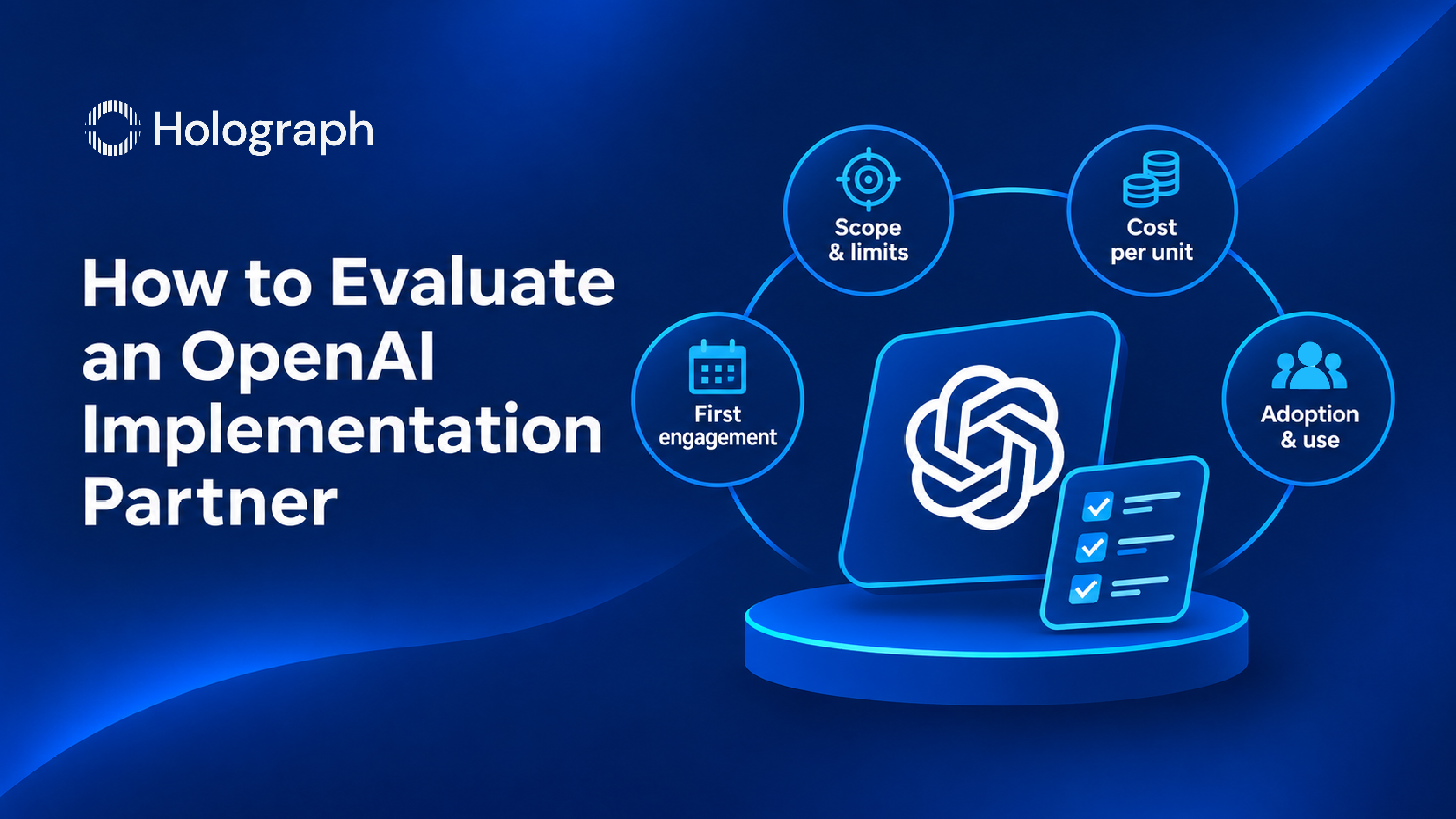
- Four questions separate an OpenAI implementation partner that has done this work from one that has read about it: what the AI may do without a person, what the first engagement commits to, what a unit of work will cost, and who will be using it in six months.
- Deloitte found 71% of companies track total AI spend and only 44% track per-unit inference cost. Capgemini found 61% of AI spending can be tracked and only 45% can be tied to verified business value.
- Deployment count is the most common selection criterion and one of the weakest, because an AI program rarely fails on the model itself.
- Holograph is part of the OpenAI Partner Network, and our AI engagements start with a two-week fixed-scope assessment that ends in a document the client keeps.
The constraint moved, and OpenAI said so first
When OpenAI announced its Partner Network on 14 June 2026, it opened with a diagnosis rather than a product claim. In its own words, "the limiting factor for seeing value from AI in the enterprise is no longer model capabilities. Instead, it's how organizations repeatably identify the right use cases, redesign workflows, integrate with existing systems, and drive adoption and change management at scale."
That is the model vendor saying the model is not the hard part. It is an unusual thing for a frontier lab to publish, and it is the most useful sentence available to anyone buying AI services this year, because it tells you where to point your scrutiny.
The survey data agrees. Deloitte's 2026 State of AI in the Enterprise, run across 3,500 director to C-suite leaders in 25 countries, found 81% reporting faster decision making and execution. Only 25% said they were using AI to change the business itself, by building new products, rebuilding core processes, or changing the model they operate on. Speed arrived. The change mostly did not.
What the tier tells you, and what it does not
The Partner Network sorts partners into three tiers: Select, Advanced and Elite. OpenAI assesses all three against the same four measures, which are sales performance, technical capability, co-sell engagement and deployment experience. Specializations in areas including Codex, cybersecurity and agents were announced alongside the tiers, and OpenAI's wording is that partners "will also be able to earn" them, which is future tense and worth reading as written.
Two things follow that a buyer should know before weighting any of it. OpenAI publishes no numeric threshold for any tier. There is no revenue floor, no certified headcount and no deployment count in the public program material, so a tier records a firm's standing with OpenAI rather than a figure you can compare across vendors. The tier also describes a position in a program, not the work the firm will do for you. Those are separate questions, and only the second one is yours.
We are part of the OpenAI Partner Network, and we would give you the same advice about our own standing. Ask what it means in practice, then judge the answer.
Four questions worth asking instead
None of the four below is answerable with a slide, and none is easy to answer without having done the work.
Ask what the AI may do without a person
Deloitte found that 40% of enterprises now let AI systems execute decisions or take actions without human approval, at least to a moderate degree. In the same survey, 23% said accountability is unclear when an AI system produces a bad outcome. Those two numbers belong together. Enterprises are granting autonomy faster than they are settling the question of who answers for it.
A partner who has thought about this will have a position before you ask, and the position will be specific: which actions the system may take alone, which need a person, what evidence it attaches to a recommendation, and what happens to the audit trail when someone overrides it. Ours is narrow. Our operational agents read, correlate and propose, and anything that changes a system passes a human approval gate. The same question applies to vendor-built agents already running inside your estate, which is worth working through before adding more, and we have written about how that plays out with AI agents in a service desk.
You do not have to agree with where we draw the line. You do have to know where your partner draws one, because the day it matters is the day after something goes wrong.
Ask what the first engagement commits to
Most AI programs start with a workshop that produces more ideas than anyone can fund. The useful work is the filter, not the list. A partner should be able to describe how candidate use cases get scored, which covers data readiness, business impact, technical feasibility and whatever compliance constraints apply, and should be able to say roughly how many survive the scoring. We run that filter hard. Ten candidates arriving at three funded ones is a normal result, and a list that stays at ten is a sign no filter was applied at all.
Then ask what you keep. Our engagements start with a fixed-scope assessment of two weeks that ends in a written document, and the document is yours whether or not the work continues. That is a small commitment, and small is the right size for a first one. A partner unwilling to put a boundary on the first engagement is asking you to buy the second one before you have seen the first.
Ask what it will cost per unit of work
This is the question most procurement conversations skip, and it is the one that decides whether a program survives its second year. Deloitte's figures show a visibility hierarchy that thins out as it approaches anything actionable. 71% of companies track total AI inference and API spend. 51% track token volume. 44% track per-unit inference cost. The total bill is visible. What produced it stays out of view.
Capgemini's September 2026 survey of 500 senior executives puts the other half of the problem in one line: 61% of AI spending can be systematically tracked, and only 45% can be connected to verified business value. The same research found that among organizations reporting cost overruns the overrun averaged 24% above budget, and that CFOs now help approve major AI investments at 52% of organizations, up from 42% a year earlier. Finance has already noticed.
A partner should be able to tell you what a unit of work will cost before it is built, which model handles which task and why, and how token consumption gets attributed back to a team that can be named. We treat this as its own discipline rather than a line on an invoice, in the same way we treat software licensing across multi-vendor estates. A day rate is not an answer to this question.
Ask who will be using it in six months
Adoption is the failure nobody budgets for. Deloitte found 60% of companies have redesigned jobs around AI capabilities to at least a moderate degree, and only 15% report a real shift in decision making authority as a result. People got better information and faster answers. They did not get permission to work differently, so the work did not change and the productivity gain never arrived.
That gap is organizational rather than technical, and it does not close on its own. Enablement is the part of the work that looks least like engineering and predicts the most, and it is the line item cut first when a program runs late. Ask who gets trained, when, and what happens to the people whose jobs change shape. Ask what gets measured after launch and when the first measurement lands. A program that cannot say how it will know whether it worked has already decided not to find out.
The question that sounds right and is not
Deployment count is the criterion most buyers reach for first, phrased as a delivery track record or production deployments in your industry. It is an intuitive test and a weak one.
Consider what it measures. Deployment count records how many times a firm has finished a project. That is informative about scale and says almost nothing about the four questions above. A firm can hold twenty finished deployments and no position on autonomy boundaries, no scoring method for use cases, no unit cost model and no enablement plan, because none of those were required to finish the twenty.
A deployment history in another industry also travels badly. The constraints that make enterprise AI hard are specific to the estate it lands in: which systems hold the data, which approvals already exist, who is allowed to see what, and which of those were designed before anyone considered that a model might read them.
Consider what fails. An AI program's failure mode is almost never that the model did not work. It is that nobody agreed what the system was allowed to do, or the use case was chosen by enthusiasm, or the cost became visible only at renewal, or the thing shipped and nobody used it. Deployment count predicts none of those.
We will state our own interest plainly, because the argument is easier to judge when you can see it. Our AI deployments are in progress rather than finished, so a test built on anything other than deployment count suits us. Read the reasoning on its merits rather than on ours. The merits are in the paragraph above, and they hold whoever is making the argument.
Where we fit
Our AI work covers six things: selecting use cases against a measurable return, licensing, implementation, enablement across whole teams rather than a pilot squad, measurement after launch, and cost control at the token and model level. Each line starts with a fixed-scope assessment that ends in a document you keep.
We are an Atlassian Solution Partner across ITSM, Cloud and DevOps, an AWS Advanced Tier Services Partner, and part of the OpenAI Partner Network. Our client work sits in enterprise estates where new systems have to live alongside the ones already running, which is the condition most of this article describes.
Start with a two-week assessment and keep the document, whatever you decide next.
Frequently asked questions
What does an OpenAI implementation partner actually do?
It does the work that model access does not cover: choosing which use cases are worth funding, redesigning the process around the model, connecting it to systems that already exist, getting it through security review, training the people who will use it, and measuring what changed afterwards. OpenAI describes this set of activities as the reason it built the Partner Network.
Do I need an implementation partner if I already have engineers?
Not necessarily. Engineering capacity covers the build. What it does not cover is use case selection against a return, workflow redesign across departments that do not report to engineering, and the measurement work after launch. If those are already owned by someone inside the organization, the case for a partner is weaker.
What do the OpenAI Partner Network tiers mean?
Select, Advanced and Elite, assessed on sales performance, technical capability, co-sell engagement and deployment experience. OpenAI publishes no numeric threshold for any of them, so the tier tells you a firm has a standing relationship with OpenAI and does not tell you how the firm delivers.
What should I ask about data handling before signing?
Ask which deployment model your data will sit in and what the retention terms are, since a public consumer product and an enterprise workspace carry different commitments. Then ask who inside the partner can see your data during the engagement, and what happens to it when the engagement ends.
How long should a first AI engagement be?
Short enough that you can stop. A fixed-scope assessment of a few weeks that produces a written document gives you something to act on and a decision point. Holograph runs ours at two weeks.
How do I tell whether an AI project is working?
Pick the measurement before you build, not after. That means a unit of work, a cost for it, a baseline from before the system existed, and a named person who reports the number. Projects that choose the measure after launch report activity instead, and activity is usage rather than value.
Start with a two-week assessment