DevSecOps: Building Security Into the Delivery Pipeline
DevSecOps is the practice of running security checks automatically inside the delivery pipeline, on every change, rather than as a separate review after the code is written. The name is a contraction of development, security, and operations, and the idea behind it is simple: a vulnerability found at commit time costs a fraction of one found in production, so the checks that catch it belong where the code is written, not in an audit months later.
For enterprises in regulated industries, this is not only an engineering preference. Security that lives in a manual review at the end of the cycle is slow, easy to skip under deadline, and hard to prove to an auditor. Security that runs as an automated gate on every commit is fast, consistent, and self-documenting. Here is what moving from one to the other actually involves.
Why end-of-cycle security fails
The traditional model runs a security review as a gate near release. By then the code is written, the architecture is set, and a finding means rework that is expensive and unwelcome, so security becomes the team that says no late in the process. Under deadline the review gets compressed or waived, which is how known vulnerability classes keep reaching production despite a security function existing.
The cost is not only the breach risk. It is the friction between shipping and staying secure, which pushes teams to treat the two as a trade-off. Embedding security in the pipeline removes that trade-off, because the checks run automatically and return findings while the code is still fresh in the developer's mind and cheap to change.
The gates that make up DevSecOps
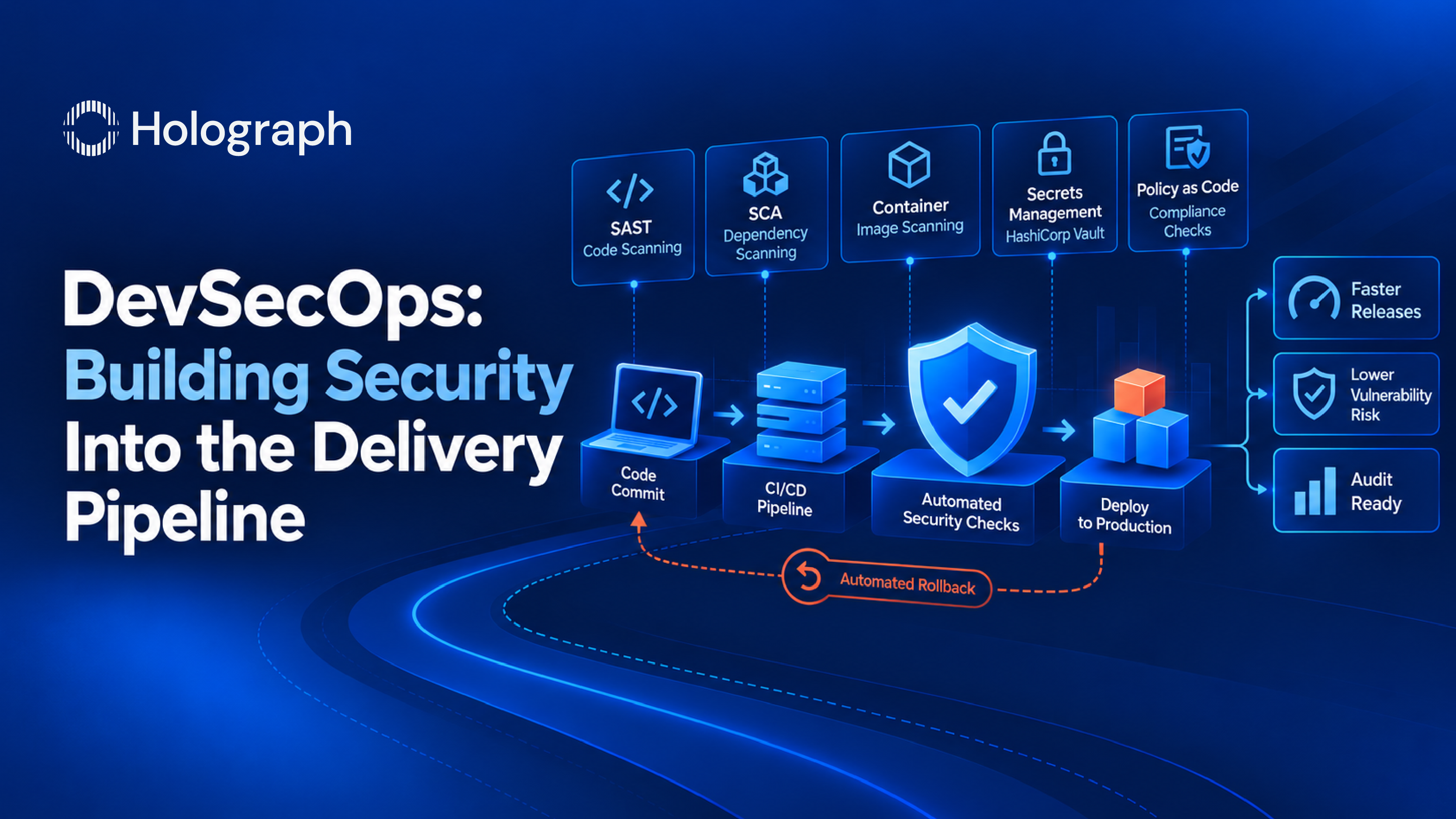
A DevSecOps pipeline is a set of automated checks, each covering a different class of risk, run on every change.
Static application security testing, or SAST, analyzes the source code itself for vulnerable patterns as it is committed. We implement this through Semgrep, our security partner for code analysis, alongside SonarQube, so insecure code is flagged in the pull request where it is written. Software composition analysis, or SCA, scans the open-source dependencies an application pulls in, because most modern code is assembled from libraries and a known flaw in one of them is a flaw in your application. Container scanning checks the images an application ships in for vulnerable packages before they reach production. Secrets management keeps credentials and keys out of the codebase and under control, which we implement with HashiCorp Vault. And policy as code enforces the security and compliance rules automatically, so a change that violates them is caught by the pipeline rather than by a person.
The point of running these as gates is consistency. Every change is checked the same way, so security stops depending on whether a reviewer had time.
Gates that inform, not just block
A common failure in DevSecOps is turning every finding into a hard stop, which floods developers with alerts and trains them to ignore or bypass the gates. We tune the gates so the critical issues block a deployment and the rest inform, arriving in the pull request with the context and the remediation guidance a developer needs to fix them. Security that a team can act on is security that gets acted on. Gates that only obstruct get routed around, which is worse than not having them.
The compliance dividend
For financial services, insurance, government, and healthcare technology, the pipeline does more than catch vulnerabilities. It generates the evidence. Every scan, every result, and every gate decision is recorded as the pipeline runs, so the record of what was checked and when is produced automatically rather than assembled by hand before an audit. Audit preparation stops being a project and becomes a report. This is the same discipline we bring to legacy estates: for TechMah CMF, a medical devices technology company, we integrated SonarQube into the build of legacy C and C++ applications, bringing automated code analysis to code that predated the practice. The scope was the internal delivery tooling, and the principle held: security and quality gates apply to established systems, not only to new ones.
How we implement it
We start from the existing pipeline rather than replacing it. The security gates are added to the CI/CD pipeline that builds and deploys the application, so they run as part of delivery rather than beside it. We prioritize the highest-risk classes first, tune the gates so they inform rather than overwhelm, and set the policy that decides what blocks and what warns. Then we hand the running pipeline to the engineering team with the remediation patterns documented, so the security practice is owned inside the team rather than dependent on an outside review. Because the gates attach to the pipeline, this work builds directly on the CI/CD pipeline that carries them.
Security that keeps pace with delivery
The reason to embed security is that it lets a team ship faster and stay secure at the same time, rather than choosing between them. When the checks run automatically on every change, frequent releases do not mean more exposure, because every release was scanned. DevSecOps is one capability inside a wider DevOps engagement, covered end to end in our guide to enterprise DevOps services.
Ready to build security into your pipeline?
If your security review still sits at the end of the cycle and audit preparation is a scramble, embedding the checks in the pipeline fixes both. We start with your existing pipeline and add the gates that fit your risk and compliance profile. Reach out to talk through where your delivery security is today.
Frequently asked questions
What is DevSecOps?
DevSecOps is the practice of building automated security checks into the software delivery pipeline so they run on every change, rather than reviewing security separately near release. It covers static code analysis, dependency and container scanning, secrets management, and policy enforcement, catching vulnerabilities at commit time where they are cheapest to fix.
What does "shift left" mean in security?
Shifting left means moving security earlier in the development process, toward the point where code is written, instead of leaving it to a review near release. The earlier a vulnerability is caught, the cheaper and simpler it is to fix, which is why DevSecOps runs its checks at commit time rather than at the end.
What is the difference between SAST, SCA, and DAST?
SAST (static application security testing) analyzes your own source code for vulnerable patterns. SCA (software composition analysis) scans the open-source dependencies your application uses for known flaws. DAST (dynamic application security testing) tests the running application from the outside. They cover different risk classes and are used together for full coverage.
Does building in security slow delivery down?
No, when it is done well. Automated gates run as part of the pipeline in the background, and tuning them so critical issues block while the rest inform keeps developers moving. The slow path is the opposite: a manual security review at the end that holds up every release and finds problems when they are most expensive to fix.
How does DevSecOps help with compliance?
The pipeline records every scan and gate decision as it runs, so the evidence an auditor needs is generated automatically rather than assembled by hand. For regulated industries, this turns audit preparation from a manual project into a report, while keeping security controls consistent on every change.
Security still bolted on at the end?