Atlassian Data Center End-of-Life: The Complete 2026-2029 Roadmap for Enterprise Transformation
On September 9, 2025, Atlassian confirmed what many enterprise IT leaders had anticipated: Data Center products will reach end-of-life on March 28, 2029. This announcement affects thousands of organizations running Jira Software, Jira Service Management, Confluence, Bamboo, and Crowd on self-managed infrastructure. With global cloud spending projected to reach $723.4 billion in 2025, the shift reflects broader enterprise migration trends already reshaping IT operations worldwide.
For companies still evaluating their options, the timeline provides a structured three-year window for migration planning. Organizations exploring cloud migration strategies will find that early preparation significantly reduces risk and cost. The transition represents both a technical challenge and an opportunity to modernize enterprise workflows with AI-powered capabilities now available exclusively in Atlassian Cloud.
Understanding the complete roadmap helps IT leaders make informed decisions about licensing renewals, budget allocation, and partner engagement.
The Official Timeline: Four Critical Milestones
Atlassian has structured the transition across four distinct phases, each with specific implications for purchasing, support, and operational continuity.
December 16, 2025 marks the first restriction. After this date, Atlassian Marketplace will no longer accept new Data Center app submissions. Existing apps continue to function, but the ecosystem effectively freezes for new development. Organizations relying on specialized Marketplace apps should audit their current stack and identify cloud-compatible alternatives.
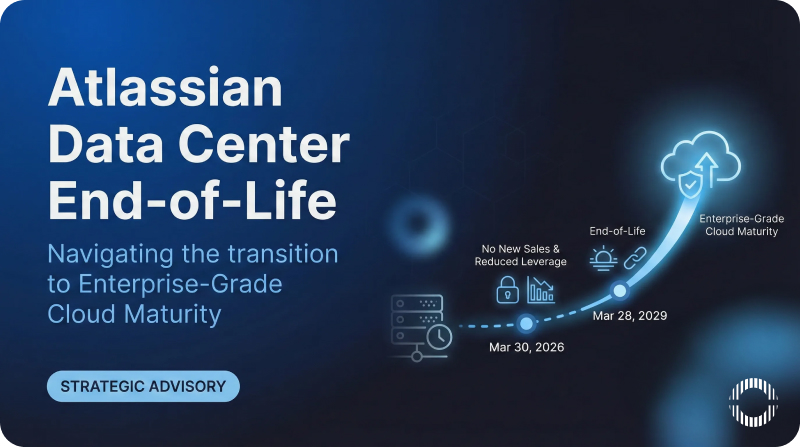
March 30, 2026 introduces purchasing restrictions for new customers. Organizations without existing Data Center licenses cannot purchase new subscriptions after this date. This deadline creates urgency for companies considering the Data Center as a temporary stepping stone before cloud migration. Those evaluating whether the March 2026 deadline affects their planning should assess current licensing status immediately.
March 30, 2028 ends all expansion options for existing customers. After this date, organizations cannot purchase additional user tiers, new product licenses, or Marketplace app subscriptions. Growth-stage companies and those planning acquisitions need to factor this limitation into capacity planning.
March 28, 2029 is the final end-of-life date. All Data Center subscriptions expire at 23:59 PST. Instances become read-only, meaning teams can view historical data but cannot create, edit, or collaborate on new work. Technical support and security updates cease entirely.
Products Affected and Notable Exceptions
The end-of-life applies to most self-managed Atlassian products. Jira Software Data Center, Jira Service Management Data Center, Confluence Data Center, Bamboo Data Center, and Crowd Data Center all follow the March 2029 timeline. Data Center mobile apps and all associated Marketplace apps for these products also reach end-of-life.
Two significant exceptions exist. Bitbucket Data Center will not be end-of-life. Instead, existing customers gain access to a hybrid license model allowing simultaneous use of Bitbucket Data Center and Bitbucket Cloud. This approach acknowledges that source code repositories often require longer migration timelines due to security and compliance considerations.
Jira Align Data Center is also excluded from the end-of-life announcement. Organizations using Jira Align for scaled agile planning maintain their current deployment options.
What Happens After Subscriptions Expire
Organizations that do not migrate by March 28, 2029 face immediate operational constraints. According to Atlassian's official documentation, expired instances become read-only. Users can access historical data for reference, but all collaborative functionality stops.
No new security patches will be provided after the end-of-life date. Atlassian explicitly warns against running expired instances while connected to the internet, as vulnerabilities discovered after March 2029 will remain unpatched. Organizations in regulated industries face particular risk, as compliance frameworks typically require current security updates.
The data itself remains accessible in read-only mode indefinitely, but without support for technical issues. Atlassian recommends implementing backup procedures well before subscription expiration to ensure continued access to historical records regardless of instance status. Enterprise teams should evaluate disaster recovery requirements as part of their cloud migration planning.
Support and Maintenance Through the Transition
Through March 28, 2029, Atlassian committed to providing technical support, security bug fixes for critical vulnerabilities, and connectors between Data Center products and Atlassian Cloud. This maintenance window allows organizations to run hybrid environments during phased migrations.
For organizations facing unique circumstances that prevent migration by the deadline, Atlassian offers extended maintenance by exception. This option requires direct engagement with Atlassian account teams and is not automatically available. Companies anticipating delays should initiate conversations early to understand eligibility and terms.
The Atlassian Migration Program provides free tools, resources, and support channels throughout the transition. Cloud Migration Assistants for Jira, Confluence, and Bitbucket handle data transfer mechanics. Solution Partners with cloud specialization offer hands-on implementation support for complex environments.
Why Atlassian Made This Decision
The strategic rationale centers on AI capabilities and platform innovation. Atlassian reports that 99% of customers are either in the cloud or actively migrating, including 75% of regulated and enterprise customers. This concentration allows Atlassian to focus development resources on cloud-native features.
Cloud-exclusive capabilities include Rovo AI automation, the Teamwork Graph for interconnected data, and advanced analytics. Atlassian's cloud-first strategy aligns with the broader market direction toward SaaS adoption.
The company shipped over 1,000 new features for cloud in 2024 at a rate of 8,000 deployments per month. Data Center customers historically waited months or years for features that cloud customers received immediately. The end-of-life decision consolidates development velocity on a single platform.
Migration Programs and Support Options
Atlassian provides several programs to facilitate transitions. The FastShift Program targets organizations with 1,000 or more users, offering dedicated support from migration experts, Solution Partners, and Advisory Services. Participants typically reduce migration timelines from 12-16 months to 2-6 months.
Solution Design Acceleration serves organizations with 5,000 or more users requiring complex, customized migration planning. This program provides dedicated partnership throughout the transformation process.
Free cloud migration trials last the duration of existing Data Center subscriptions, up to 12 months. Organizations can explore Standard and Premium Cloud features, build proof-of-concept environments, and conduct user acceptance testing before committing to full migration.
Dual licensing eliminates double payment during transitions. Organizations running parallel cloud and Data Center environments pay only for cloud subscriptions while maintaining access to self-managed instances through the migration period.
Planning Considerations for Enterprise Teams
Organizations comparing deployment options should evaluate several factors. The true cost comparison between cloud and Data Center extends beyond licensing to include infrastructure, maintenance staff, security patching, and disaster recovery. Cloud shifts these responsibilities to Atlassian while providing predictable per-user pricing.
Organizations with AWS cloud infrastructure can leverage existing investments during migration. Gartner predicts that 90% of organizations will adopt hybrid cloud approaches through 2027, with data synchronization across environments becoming the most urgent challenge. Organizations should assess current customizations, integrations, and Marketplace app dependencies early in the planning process.
For regulated industries, Atlassian is building FedRAMP High and Impact Level 5 environments for submission before the Data Center end-of-life date. Government customers and contractors can track authorization progress through the Atlassian Government Cloud FedRAMP announcement, which outlines the roadmap for higher security certifications.
Starting the Transition
Early engagement with Atlassian representatives helps organizations understand available incentives, discounts, and support options. Current offers include 10-20% discounts on Cloud Enterprise Edition for purchases before June 2027, step-up credits for unused Data Center maintenance, and loyalty discounts up to 40% for migrations.
The three-year runway provides adequate time for most organizations, but complex environments benefit from earlier starts. Companies with extensive customizations, large user bases, or strict compliance requirements should begin assessment phases in 2026 to allow sufficient testing and training time.
Whether your organization prioritizes AI-powered productivity, reduced infrastructure overhead, or simply maintaining access to Atlassian tools beyond 2029, the path forward runs through cloud migration. The roadmap is clear. The support infrastructure exists. The question is timing.
Frequently Asked Questions
What exactly happens on March 28, 2029?
All Atlassian Data Center products—including Jira Software, Jira Service Management, Confluence, Bitbucket, Bamboo, and Crowd—will become read-only on this date. Licenses expire, technical support ends, and security updates stop. Atlassian advises against running read-only instances on public networks due to security vulnerabilities that will accumulate without patches.
Can I still buy Data Center licenses after March 30, 2026?
Existing customers with current Data Center subscriptions can continue purchasing new licenses, expansions, and marketplace apps until March 30, 2028. After that date, you can only renew existing licenses. New customers (those without Data Center subscriptions before March 30, 2026) cannot purchase Data Center products at all.
What is the FastShift program?
FastShift is Atlassian's migration support program designed to help customers transition from Data Center to Cloud. It provides dedicated migration resources, tools, and guidance. Availability is limited, so organizations should apply early to secure program slots.
How long does a typical Data Center to Cloud migration take?
Timelines vary significantly based on environment complexity. Organizations with fewer than 1,000 users and standard configurations often complete migrations in 3-6 months. Large enterprises with multiple instances, extensive customizations, and complex integrations may require 12-24 months. Starting assessment early allows for realistic planning.
What happens to my marketplace apps?
Marketplace app migration depends on each app vendor's Cloud offering. Some apps have direct Cloud equivalents that migrate automatically. Others require finding alternatives or rebuilding functionality. After December 16, 2025, no new Data Center apps can be submitted, and after March 30, 2028, no Data Center apps can be purchased. Inventorying and evaluating your apps should be an early priority.
Is Atlassian Cloud secure enough for enterprise use?
Atlassian Cloud now supports enterprise security requirements including SOC 2 Type II certification, ISO 27001 compliance, GDPR compliance, FedRAMP authorization (for government customers), data residency controls, and isolated cloud options. Atlassian Guard provides advanced threat detection, identity management, and security analytics. Most enterprise security concerns can be addressed within Cloud's current capabilities.
What about data residency requirements?
Atlassian Cloud supports data residency in multiple regions, allowing organizations to specify where their data is stored and processed. For organizations with strict data sovereignty requirements (such as government entities in certain jurisdictions), isolated cloud options provide dedicated infrastructure. Specific requirements should be evaluated against current Cloud capabilities during assessment.


.jpg)