Why March 30, 2026 Matters: What Happens When Atlassian Stops Selling Data Center Licenses
.jpg)
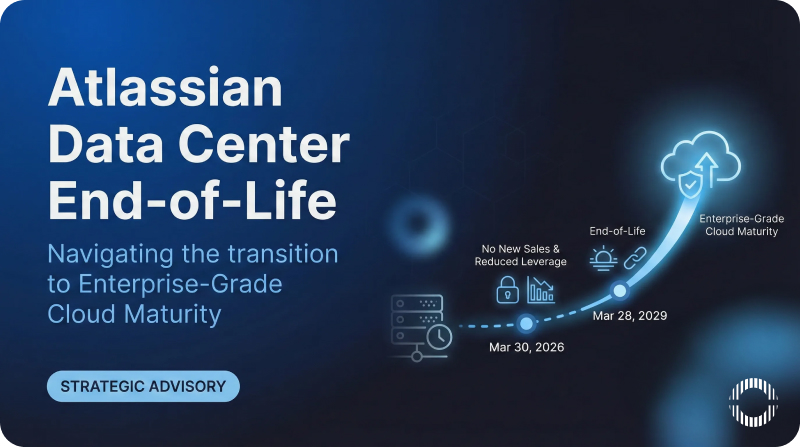
March 30, 2026 represents the first major restriction in Atlassian's Data Center end-of-life timeline. After 23:59 PST on this date, organizations without existing Data Center subscriptions lose the ability to purchase new licenses. With 77% of Atlassian's enterprise customers already maintaining a cloud footprint, this deadline forces companies still evaluating Atlassian deployment options to make decisions faster than planned.
The restriction applies to all Data Center products and associated Marketplace apps. Understanding the complete Data Center EOL roadmap helps organizations plan beyond this initial milestone. But March 2026 demands immediate attention because it eliminates optionality for thousands of organizations still weighing their choices.
What Changes on March 30, 2026
New customers face a binary choice after this date: Atlassian Cloud or nothing.
The "new customer" classification matters here. Atlassian defines existing customers as organizations with active Data Center subscriptions before March 30, 2026. If your company runs Jira Software Cloud today but wants to add Jira Service Management on Data Center infrastructure, you would be considered a new customer for that product. The restriction applies at the product level, not the organization level.
Marketplace apps follow the same pattern. New Data Center app purchases become unavailable to new customers after this date. Organizations planning to build custom workflows using third-party apps need those subscriptions active before the cutoff.
For existing customers, nothing changes immediately. License renewals, user tier expansions, and new product additions remain available until March 30, 2028. The 2026 deadline specifically targets organizations not yet in the Data Center ecosystem.
Who This Affects Most
Three groups face the most pressure from this deadline.
Organizations currently on Server licenses already migrated to Data Center or Cloud when Server support ended in February 2024. But some companies delayed decisions, running unsupported Server instances while evaluating options. March 2026 closes the Data Center path for these organizations permanently.
Growing companies considering self-managed infrastructure for compliance, data residency, or control reasons must decide quickly. After March 2026, cloud becomes the only entry point to the Atlassian ecosystem. Organizations running ITSM workflows should evaluate how Rovo AI agents are transforming service desk operations in cloud environments before assuming self-managed is the only viable path.
Mergers and acquisitions create complexity here. A parent company with Data Center licenses cannot extend those subscriptions to cover a newly acquired subsidiary after March 2026. Each entity's customer status is evaluated independently.
The Strategic Calculation
Some organizations are racing to purchase Data Center licenses before March 2026, even without immediate deployment plans. The logic: secure optionality now, decide later.
This approach carries risk. Data Center subscriptions require annual renewal payments whether you use the software or not. Purchasing licenses speculatively means committing a budget to maintain options that may never be exercised. And the final end-of-life in March 2029 means even secured licenses have a three-year expiration regardless.
The counterargument: certain industries face regulatory requirements that genuinely prohibit cloud deployment today. Healthcare organizations handling protected health information, government contractors with data sovereignty requirements, and financial institutions under strict audit controls may need self-managed infrastructure. According to Gartner's 2024 security forecast, global information security spending will reach $212 billion in 2025, driven by cloud movement and evolving threats. For these organizations, securing Data Center access before March 2026 preserves compliance pathways while Atlassian continues expanding its compliance certifications for cloud deployments.
Making the Decision
The honest assessment: most organizations should migrate to the cloud rather than racing to secure Data Center licenses.
McKinsey's 2024 cloud research projects that cloud adoption could generate $3 trillion in value for enterprises that move beyond basic adoption to full optimization. Atlassian reports 99% of customers are either in the cloud or actively migrating.
Before committing, evaluate the true cost differences between cloud and Data Center deployments. Factor in infrastructure costs, maintenance staff, security patching, and disaster recovery when comparing options. Cloud pricing looks higher on paper but often delivers lower total cost of ownership when all factors are included.
For organizations with genuine regulatory constraints, March 2026 requires action. Engage Atlassian account teams now to understand licensing options and explore whether cloud architectures with data residency controls might address concerns that previously required self-managed infrastructure.
What Comes Next
March 2026 is the first domino. March 2028 ends expansion options for existing customers. March 2029 ends everything.
Organizations purchasing Data Center licenses now are buying time, not a permanent solution. Every Data Center customer will eventually face cloud migration or tool replacement. The question is whether that migration happens on your timeline or Atlassian's.
Start the conversation with your team now. Audit current Atlassian usage, identify compliance constraints, and map dependencies. Whether you secure Data Center licenses before March 2026 or begin cloud migration immediately, informed decisions require understanding what your organization actually needs from its collaboration tools.
The deadline is real. The clock is running.
Frequently Asked Questions
Can I still renew my existing Data Center subscription after March 30, 2026?
Yes. Existing customers can continue renewing until March 30, 2028. The March 2026 deadline only affects new customers who have never purchased Data Center products.
What if I need a Data Center but my procurement process takes longer than ten weeks?
Contact an Atlassian Solution Partner immediately. Partners can sometimes expedite quotes and procurement to meet urgent deadlines. However, internal approval processes may still create challenges. If procurement cannot be completed by March 30, Cloud becomes your only option.
Does this affect Bitbucket Data Center?
Bitbucket receives special treatment. Atlassian offers a dual-license option where organizations can maintain Bitbucket Data Center while accessing Bitbucket Cloud innovations with a single license. This exception recognizes that code repositories have unique requirements around data locality and integration.
What happens if I purchase a Data Center now but decide to migrate to Cloud later?
You maintain full flexibility. Dual licensing means you can run both platforms simultaneously during migration without paying double. Step-up credits let you convert unused Data Center value to Cloud subscriptions. Purchasing now preserves options; waiting eliminates them.
Is Cloud really ready for enterprise deployment?
Atlassian Cloud has matured significantly. Enterprise features like unlimited storage, sandbox environments, advanced admin controls, and comprehensive data residency options now match or exceed Data Center capabilities for most use cases. The introduction of Rovo AI agents and platform-level analytics provides capabilities that Data Center cannot offer. We examine this evolution in detail in our Cloud vs. Data Center: The True Cost Comparison article.
How long does a typical migration take?
Standard migrations require 6-12 months depending on complexity. Organizations participating in Atlassian's FastShift program can reduce this to 2-6 months. Factors that extend timelines include heavy customization, numerous Marketplace apps, complex integrations, and organizational change management requirements.