Software License Management vs SAM vs FinOps: Choosing the Right Approach
Key Takeaways
- SAM tools, FinOps practices, and managed license services are three distinct approaches to controlling software spend, and most enterprises need a combination rather than a single solution.
- The IDC MarketScape for SAM Managed Services (2025–2026) is the first-ever analyst assessment of the managed SAM services market, evaluating 11 global providers and signaling that managed services have matured into a recognized category alongside traditional SAM tools and FinOps platforms.
- SAM tools excel at inventory and compliance but stop short of negotiation and ongoing governance. FinOps excels at cloud consumption optimization but ignores SaaS seat licenses and on-premises entitlements. Managed license services bridge both gaps with vendor negotiation, cross-portfolio optimization, and continuous monitoring.
- The decision framework for software license management vs SAM vs FinOps depends on vendor count, license spend, internal expertise, and whether the organization needs compliance defense, cost optimization, or both.
Introduction
The question of software license management vs SAM vs FinOps surfaces in nearly every enterprise that reaches a certain scale of software spend. The IT leadership team recognizes that license costs are climbing, that compliance risk is real, and that some form of governance is overdue. What follows is usually a confusing evaluation of overlapping acronyms and vendor pitches that all claim to solve the same problem.
They do not solve the same problem. SAM (Software Asset Management), FinOps (Financial Operations for cloud), and managed license services each address a specific slice of the software cost challenge. Understanding where each approach starts and stops is the prerequisite for making the right investment. The Gartner 2026 Market Guide for SAM Tools reports that 61% of procurement leaders describe their software asset data as disorganized, inaccurate, or in need of major quality improvements. That statistic alone explains why the "which approach?" question matters: the wrong choice means pouring resources into a solution that cannot compensate for the organization's actual gaps.
This article breaks down what SAM tools, FinOps platforms, and managed license services each deliver, where they fall short, and how enterprises are combining them to capture the full optimization opportunity.
What SAM Tools Do Well
Software Asset Management tools are the longest-established category in this comparison. Products like Flexera, Snow Software, ServiceNow SAM, and newer entrants like Pathlock and USU provide automated software discovery, license inventory management, and compliance tracking.
The core value of a SAM tool is visibility. It scans the environment, catalogs installed software, reconciles discovered installations against purchased entitlements, and flags compliance gaps. For enterprises that genuinely do not know how many licenses they own or how many are in active use, a SAM tool is the foundational layer. Without that visibility, every other optimization effort is guesswork.
The SAM market reflects this foundational role. SNS Insider's January 2026 analysis projects the global SAM market growing from $3.87 billion in 2025 to $13.03 billion by 2033, a 17.59% compound annual growth rate driven by SaaS adoption and license compliance requirements. That growth trajectory confirms that enterprises are investing heavily in the data layer of license governance.
Where SAM tools stop
SAM tools are, fundamentally, data platforms. They tell you what you have, what you are entitled to, and where the gaps are. They do not negotiate with vendors. They do not manage renewal timing. They do not optimize cross-vendor spend. And they require significant internal expertise to configure, maintain, and interpret.
The Gartner 2026 Market Guide makes this limitation explicit, noting that SAM and FinOps functions must converge to bridge data gaps and optimize software spending in cloud environments. The implication is clear: SAM tools alone are not sufficient for enterprises running hybrid environments with a mix of on-premises, SaaS, and cloud consumption models.
An organization that deploys a SAM tool without the internal team to act on its findings ends up with an expensive compliance dashboard that nobody uses strategically.
What FinOps Covers
FinOps emerged from the cloud-native community as a discipline for managing cloud consumption costs. The core practice involves real-time visibility into cloud spend, usage optimization (right-sizing instances, eliminating idle resources), and organizational accountability through cost allocation and showback models.
For enterprises with significant AWS, Azure, or Google Cloud spend, FinOps delivers measurable savings on the consumption side of the ledger. As we've explored in detail, FinOps platforms track resource utilization by the hour, identify underused reserved instances, and surface optimization opportunities that infrastructure teams can act on immediately.
Where FinOps misses
The coverage gap becomes apparent the moment you look beyond cloud infrastructure. FinOps was not designed to manage SaaS seat licenses (Microsoft 365, Atlassian Cloud, Adobe Creative Cloud, Salesforce), on-premises entitlements (perpetual licenses, maintenance agreements), or the contract negotiation layer that determines pricing for all of the above.
When an enterprise evaluates software license management vs SAM vs FinOps, the FinOps component typically covers 30–40% of total software spend (the cloud consumption portion) while leaving the remaining 60–70% (SaaS subscriptions, on-premises licenses, enterprise agreements) unoptimized. This is not a criticism of FinOps as a practice; it is a recognition that the practice was designed to solve a specific problem, and that problem is narrower than total software cost governance.
What Managed License Services Deliver
Managed license services represent a fundamentally different model. Rather than providing a tool that an internal team operates, managed services providers deliver outcomes: reduced license costs, improved compliance, optimized renewals, and ongoing governance, with the provider's team doing the analytical and negotiation work.
The IDC MarketScape for SAM Managed Services (2025–2026) is the first-ever analyst assessment of this category, evaluating 11 global providers. That IDC chose to create this assessment for the first time signals a market inflection: managed SAM services have moved from niche offering to recognized category. IDC analyst Nishant Bansal notes that providers combining automation, analytics, and informed advisory guidance are best positioned to help enterprises optimize spending, manage risk, and align software investments with business priorities.
The managed services model addresses the gaps that SAM tools and FinOps leave open:
Vendor negotiation. SAM tools identify that you have 500 unused Microsoft E5 licenses. A managed services partner negotiates the true-down with Microsoft, potentially restructures the agreement to a more favorable tier, and ensures the renewal terms reflect actual usage rather than historical commitments. This negotiation layer is where the largest cost savings materialize, and it is the capability that neither SAM tools nor FinOps platforms provide.
Cross-vendor optimization. When a single partner manages the license portfolio across Atlassian, Microsoft, Adobe, AWS, Google, and GitLab, they can identify optimization opportunities that vendor-specific tools miss. Budget that is being wasted on underused Adobe Creative Cloud seats might be better redirected to an Atlassian Cloud tier that the development team actually needs. That cross-vendor perspective is impossible when each vendor relationship is managed in isolation.
Continuous governance. Managed services providers monitor the license environment on an ongoing basis, catching utilization changes, compliance drift, and renewal windows before they become problems. This stands in contrast to the SAM tool model, where the tool provides the data but the internal team must find the time and expertise to act on it.
CompTIA's 2025 IT Industry Outlook found that managed services deliver equivalent expertise at 25–45% lower cost than building in-house teams, which explains why the model is gaining traction even among enterprises that already have SAM tools deployed.
Side-by-Side Comparison
The decision of software license management vs SAM vs FinOps comes down to eight dimensions. The table below summarizes where each approach excels and where it has limitations.
| Dimension | SAM Tools | FinOps Platforms | Managed License Services |
|---|---|---|---|
| Scope | On-prem + SaaS inventory, compliance | Cloud consumption (IaaS/PaaS) | Full portfolio: on-prem, SaaS, cloud, contracts |
| Primary value | Visibility and compliance | Cloud cost optimization | Cost reduction, compliance, and vendor negotiation |
| Vendor coverage | Multi-vendor inventory (discovery-based) | Cloud providers (AWS, Azure, GCP) | Multi-OEM (Atlassian, Microsoft, Adobe, AWS, Google, GitLab) |
| Negotiation capability | None (data only) | None (optimization recommendations only) | Active vendor negotiation on renewals, true-downs, restructuring |
| Internal effort required | High (configuration, maintenance, interpretation) | Medium (tagging, allocation, governance culture) | Low (provider manages analysis, negotiation, monitoring) |
| Speed to value | 6–12 months (deployment + data normalization) | 3–6 months (integration + cultural adoption) | 1–3 months (assessment + first optimization cycle) |
| Compliance defense | Strong (audit-ready reporting) | Weak (not designed for license compliance) | Strong (audit prep + negotiation support) |
| Best for | Enterprises with large internal SAM teams | Cloud-heavy organizations with FinOps maturity | Multi-vendor enterprises needing negotiation + governance |
Decision Framework: When to Use Each Approach
The right answer to the software license management vs SAM vs FinOps question depends on the enterprise's specific situation.
SAM tools make sense when the primary need is compliance defense and internal visibility, when the organization has a dedicated SAM team with the expertise to operate and interpret the tool, and when the software environment is heavily weighted toward on-premises or traditional licensing models. SAM tools are also the right starting point when the organization has never conducted a comprehensive license inventory and needs the data foundation before pursuing optimization.
FinOps makes sense when cloud infrastructure spend represents a significant and growing portion of the IT budget, when the organization has committed to cloud-first architecture, and when the primary waste is in resource utilization (oversized instances, idle resources, unoptimized reserved instances) rather than in license seat counts or enterprise agreement terms.
Managed license services make sense when the organization manages four or more major software vendors, when total license spend exceeds $2–3 million annually, when renewal cycles are consuming disproportionate procurement time, when audit risk is a board-level concern, or when the organization lacks the internal expertise to negotiate effectively with enterprise software vendors. This is where a partner like Holograph delivers outsized value, leveraging multi-OEM relationships across 170+ enterprise engagements to negotiate terms that internal teams cannot achieve independently.
The Hybrid Model
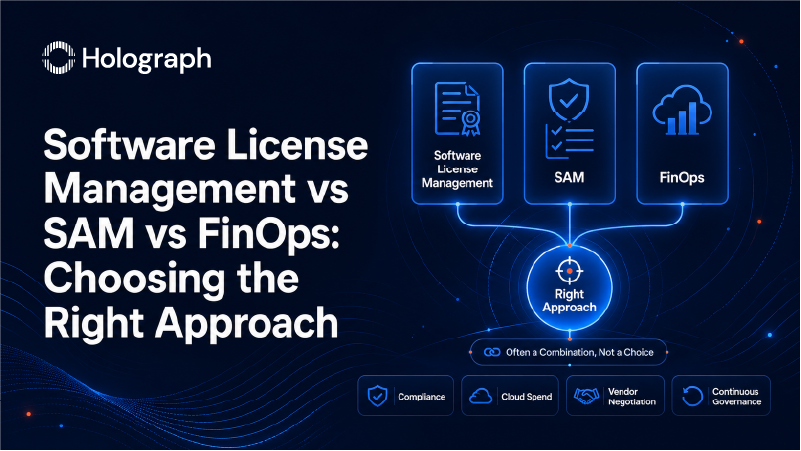
The most effective enterprises do not treat software license management vs SAM vs FinOps as an either-or decision. They combine SAM tools as the data layer, FinOps as the cloud optimization practice, and a managed services partner as the strategic and negotiation layer.
In this model, the SAM tool provides continuous inventory and compliance data. The FinOps practice manages cloud consumption in real time. And the managed services partner uses both data sources to drive vendor negotiations, optimize the full software portfolio, and govern the ongoing renewal cycle. Each component does what it does best, and the gaps that exist in any single approach are covered by the others.
The IDC MarketScape notes this convergence trend explicitly, identifying unified SAM + FinOps operating models as a key market development. The enterprises that capture the full 30–40% optimization opportunity described in our comprehensive guide are typically the ones running this hybrid model rather than relying on any single approach.
For CIOs managing multi-vendor portfolios, the implication is straightforward: evaluate each approach for what it contributes, not for what it claims to be. The alphabet soup of SAM, ITAM, FinOps, and SLM resolves itself once you understand that these are complementary capabilities, not competing solutions.
Related Reading
- Enterprise Guide to Software Licensing Management: How to Cut 30% of License Waste (Pillar page)
- Why Cloud FinOps Fails Without Strong Software License Management (TOFU-2 deep dive on the FinOps gap)
- What Every CIO Should Know About Multi-Vendor License Management in 2026 (CIO decision framework)
- Holograph vs Traditional SAM Tools: When a Services Partner Beats a Tool-Only Approach (BOFU comparison)
- Software Licensing Management and Cost Optimization Services (Service page)
This blog is part of Holograph's Software Licensing Management content series. For a comprehensive overview of enterprise license management, read the complete pillar guide.